 Garden Surveyor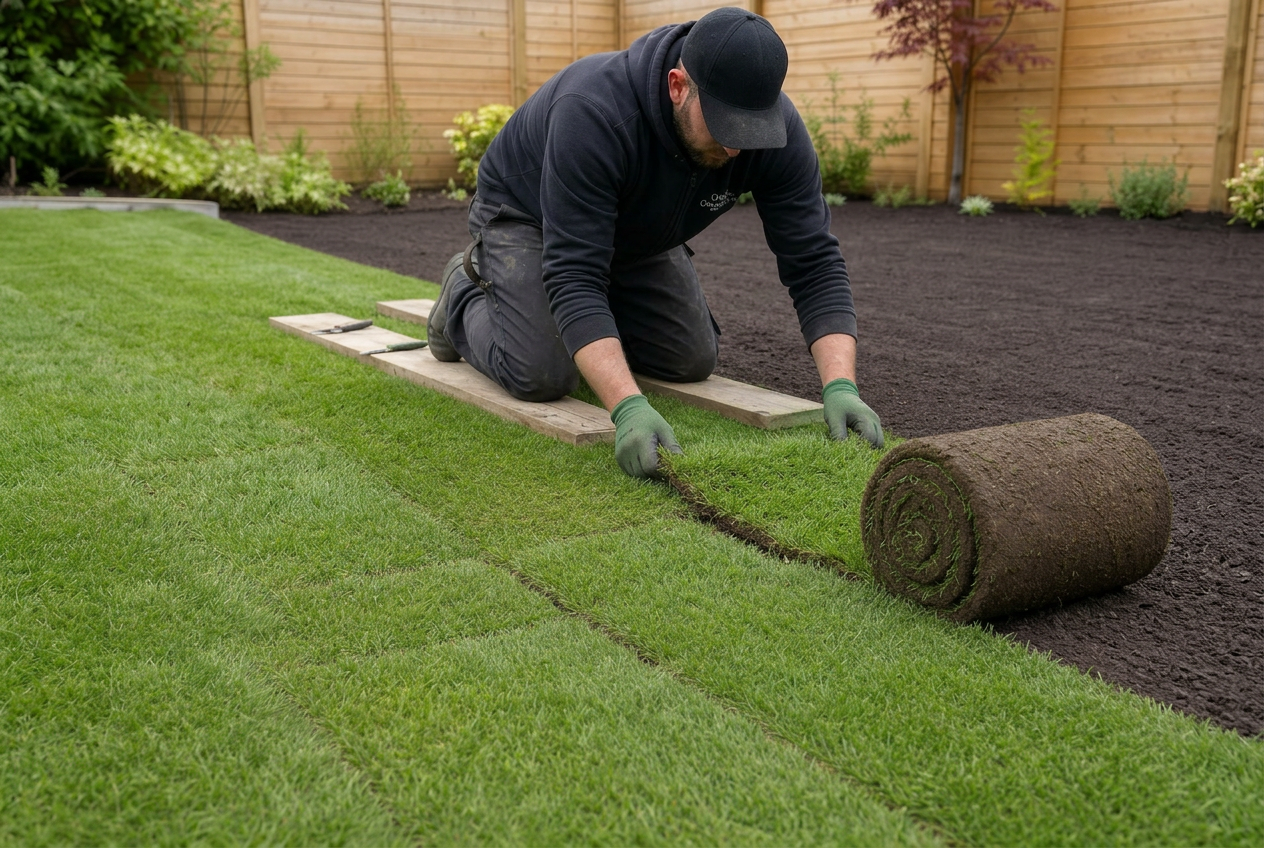
Laying turf: the quick version
A good turf lawn comes down to three things: a well-prepared, level soil bed; fresh turf laid tight with staggered joints; and plenty of water for the first few weeks. Turf is the fastest way to a usable lawn: you get an instant green surface that knits to the soil in two to three weeks, versus months for seed. This guide walks through ground preparation, the best time of year, how to lay the rolls, how much turf and topsoil you need, and the watering and aftercare that makes the difference between a lawn that thrives and one that browns off.
Choosing the Right Turf Mixture
Not all turf is the same. The seed mixture in the roll determines how your lawn looks, how much wear it can take, and how much maintenance it needs.
- Hard-wearing / Family Lawns, Needs a high percentage of Dwarf Perennial Ryegrass. It recovers quickly from kids, dogs and garden furniture.
- Ornamental / Fine Lawns, Fescue and Browntop Bent blends give a close-cut, bowling-green finish but need more mowing and handle far less traffic.
- Shaded Areas, Needs shade-tolerant species like Supranova Poa Supina or specific creeping fescues that survive with limited direct sunlight.
When is the best time to lay turf?
In the UK the best time to lay turf is autumn, when the soil is still warm from summer and regular rain does most of the watering for you. Spring is a close second. You can lay turf almost year-round provided the ground isn't frozen, waterlogged or baked hard: but summer turf needs daily watering and winter turf simply sits dormant until growth resumes.
| Season | Verdict | Notes |
|---|---|---|
| Autumn (Sep–Nov) | Best | Warm soil and natural rain, least watering needed. |
| Spring (Mar–May) | Very good | Roots establish before summer; water in dry spells. |
| Summer (Jun–Aug) | Possible | Lay only if you can water daily; avoid heatwaves. |
| Winter (Dec–Feb) | Avoid | Don't lay on frozen or waterlogged ground; turf sits dormant. |
Whatever the season, lay turf within 24 hours of delivery: it heats up and yellows quickly while rolled up.
How to prepare the ground for turf
Preparation is 90% of the job, turf will only ever be as good as the soil under it.
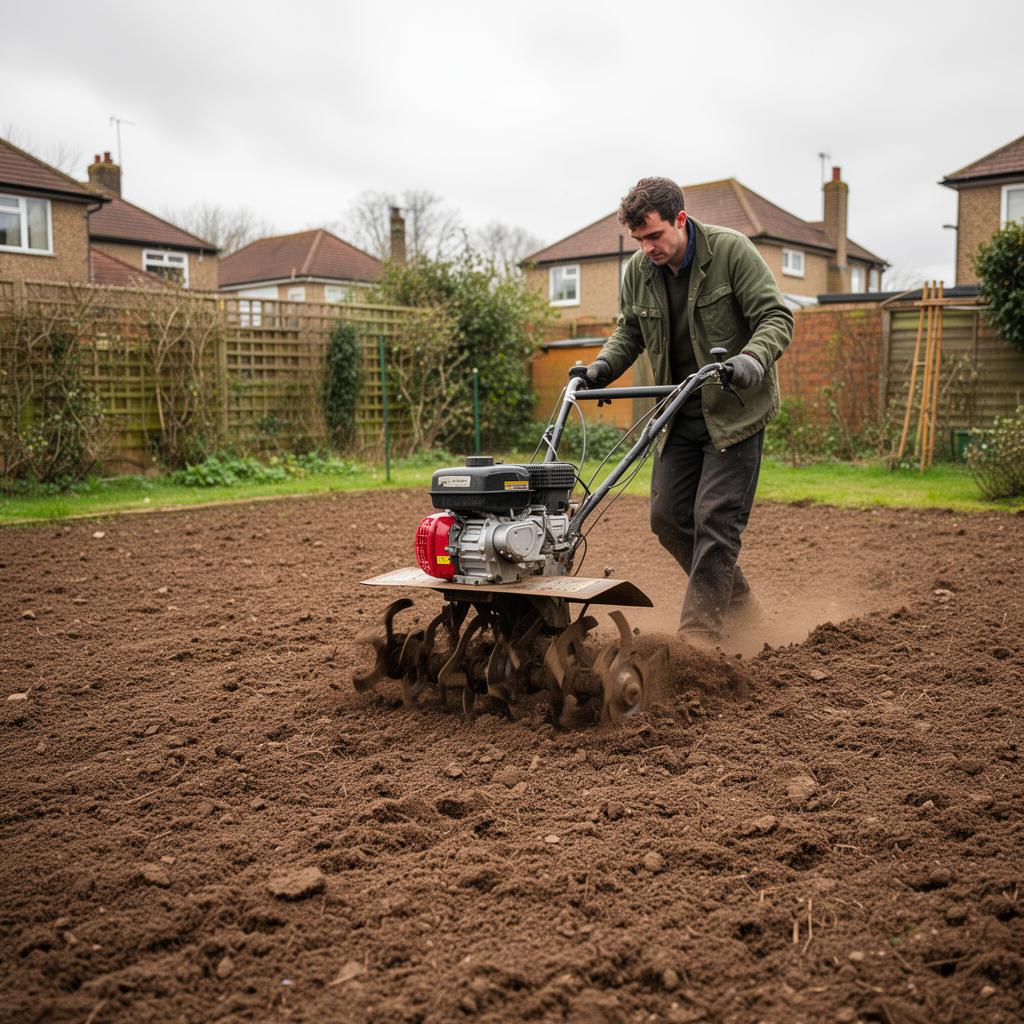
- Clear the area of old grass, weeds and stones. Kill off perennial weeds first if the area is heavily infested.
- Dig over or rotavate the top 100–150 mm to relieve compaction, removing weed roots and debris as you go.
- Spread 25–50 mm of quality topsoil over reasonable ground, or 100–150 mm over poor, compacted or builder's ground.
- Firm the soil by treading evenly or using a light roller, then rake level, fill hollows so water can't pool.
- Rake to a fine, crumbly tilth and apply a pre-turf fertiliser (about 35 g/m² of a balanced NPK feed) a few days before laying.
How to level the soil before laying turf
A truly level bed is what gives turf its flawless finish: every lump or hollow telegraphs straight through the grass and can't be fixed once the rolls are down. Level in two stages: rough level, then fine level.
- Rough level. Rake the dug or rotavated soil in several directions to knock down high spots and drag soil into hollows.
- Firm it. Tread the whole area evenly on your heels, or use a light roller, to reveal soft spots that would later sink.
- Set a datum. For larger or sloping lawns, knock in pegs marked to your finished level and run a string line or drag a long straight-edge across them to spot dips.
- Fine level. Fill remaining dips with topsoil, re-rake to a crumbly tilth, and repeat firm-and-rake until the surface is true and water can't pool.
How to lay turf: step by step
- Start along a straight edge, a path, patio or string line, and lay the first full row, butting rolls tightly end to end.
- Lay the next row with the joints staggered like brickwork, so the ends never line up across rows.
- Always kneel and work from a board laid on the turf you've already placed, never tread directly on freshly laid rolls.
- Butt each roll firmly against its neighbours without stretching it; turf shrinks as it dries, so stretched joints open into gaps.
- Trim edges, curves and around obstacles with a sharp knife or half-moon edger, and brush a little soil into any joints.
- Firm the whole lawn down with a roller or the back of a rake, then water it in thoroughly straight away.
How to stagger turf joints (brick-bond)
Staggering: also called a brick-bond or running-bond pattern: means offsetting each row's end joints so they never line up with the row before. It's exactly how bricks are laid in a wall, and it's the single biggest thing that separates a professional-looking lawn from a patchy one.
Brick-bond staggering (top-down)
Each row of 1 m rolls is offset by about half a roll (~500 mm) so the end joints never line up.
Step by step
- Lay the first row of full rolls along your straightest edge, butting them tightly end to end.
- Start the second row with a half roll (cut one ~500 mm roll in half) so its first joint lands in the middle of the first row's roll.
- Continue that row with full rolls, every end joint now sits roughly halfway along the rolls below it.
- Begin the third row with a full roll again, the fourth with a half roll, and so on, alternating so the pattern repeats.
- Keep each row's joints at least 150–300 mm clear of the joints in the row above; never let them line up.
- Use the offcut half rolls to start alternate rows and to fill the staggered ends, almost nothing is wasted.
- Push rows tight together and brush soil into the seams; staggered joints knit far more strongly as the roots cross them.
Why staggering matters
- No continuous seams. Aligned joints create long lines that the turf shrinks back from, opening visible gaps and weak channels right across the lawn.
- Stronger knitting. Offset joints let roots from neighbouring rolls grow across each seam, binding the whole lawn into one mat instead of separate strips.
- Less erosion and drying. Straight-through joints funnel water and dry out fast; staggered joints break that path so edges stay moist and don't lift.
- An invisible finish. Once knitted, a brick-bond lawn reads as a single seamless surface, line up the joints and you'll see a grid of seams for months.
Watering & aftercare
Watering is what makes or breaks new turf. Give it a thorough soak immediately after laying so water reaches the soil beneath, then water daily in dry weather for the first two to three weeks, the soil should stay moist about 50 mm down. Lift a corner after a week or two: once you feel resistance, the roots are knitting in. Keep foot traffic off for those first few weeks, give it a first light mow (taking only the top third) once it has rooted, and hold off heavy use for a couple of months.
Once the lawn is established and you have cut it a few times, you can create clean straight or checkerboard stripes with a lawn roller or striper. See how to stripe a lawn for patterns, tools and a step-by-step guide.

Make daily watering effortless for the critical first few weeks. Partner links — we may earn a small commission if you buy, at no cost to you.
- Oscillating sprinklerGentle, even coverage so new turf gets a thorough daily soak without flooding.
- Garden hose & reelReach the whole lawn easily for the first 2–3 weeks of daily watering.
- Hose spray gun / nozzleSoft-shower setting waters in turf without washing soil out of the joints.
- Large watering canHand-water corners, edges and small lawns the sprinkler can't reach.
- Soil moisture meterCheck the soil stays moist about 50 mm down while the roots knit in.
- Tap timerAutomate early-morning watering so you never miss a day in a dry spell.
How much turf and topsoil do I need?
Turf comes in 1 m² rolls, so you need roughly one roll per square metre: plus a waste allowance of 5–7% for rectangular lawns or 10–12% for curved or complex edges. For topsoil, aim for at least 100 mm of good rooting medium overall. The turf & topsoil calculator turns your measurements into whole rolls, topsoil volume and tonnage, plus sharp sand, seed and fertiliser.
Worked example: small back lawn
5 m × 6 m = 30 m². Add 7% waste → about 33 rolls. With 50 mm of topsoil top-up: 30 × 0.05 = 1.5 m³, roughly 2 tonnes of topsoil.
Can you lay turf on existing grass?
It's tempting to roll fresh turf straight over a tired lawn, but it almost always fails. The old grass dies and rots into a spongy thatch layer that blocks new roots from reaching the soil, holds moisture against the new turf, and harbours pests and disease. Drainage suffers, weeds push up through the seams, and the leftover lumps leave the surface uneven.
Do it properly instead: there are two reliable routes:
- Strip it off. Skim the old grass away with a turf cutter or sharp spade at about 25–40 mm deep, then prepare and level the soil beneath as normal.
- Kill and incorporate. Treat the lawn with a suitable weedkiller, wait for it to die back, then rotavate it into the topsoil, rake out the debris, firm and level before laying.
Either way, finish with the same firming and levelling as a bare-soil bed so the new turf beds onto firm, true ground.
What about artificial turf?
Artificial turf is a different job: instead of soil you build a compacted sub-base of MOT Type 1 and sharp sand, lay a weed membrane, then roll out and pin the grass, joining seams with adhesive tape and brushing in a sand infill. If you're going synthetic, follow our full how to lay artificial grass guide and use the artificial grass calculator for the grass, sub-base and infill quantities, plus the sub-base guide for the right depths and compaction.
Common mistakes & how to avoid them
Most turf failures come from the same few errors. Here is what goes wrong, why it happens, and the simple fix for each.
Un-staggered seams (grid joints)
Why it fails: When end joints line up row after row they create long, continuous weak lines across the lawn. Turf shrinks as it dries, pulling back from those straight seams and opening visible gaps. Water funnels into the channels, washing out soil and drying the edges so they lift and brown.
How to avoid it: Lay in a brick-bond pattern. Start alternate rows with a half roll so every joint is offset by at least 150–300 mm from the one above. Never let two joints sit directly on top of each other.
Gaps between rolls
Why it happens: Stretching a roll to bridge a gap is the usual culprit, the turf relaxes as it dries and the gap reopens wider than before. Gaps also appear when turf is left rolled up too long and shrinks before it is laid, or when seams are not butted tight from the start.
How to avoid it: Butt each roll firmly against the last without stretching. Lay turf within 24 hours of delivery while it is still fresh. Brush a little fine soil into every seam as you go so that even a hairline gap knits closed as the roots grow.
Dips and hollows
Why it happens: A lumpy or un-firmed soil bed telegraphs straight through the turf. Footprints left during preparation, unfilled hollows, or uneven topsoil all show up as permanent dips once the turf is down and cannot be re-levelled without lifting it.
How to avoid it: Firm the whole area by treading evenly or using a light roller, then rake to a true, level tilth. Fill every hollow, even shallow ones, so water cannot pool. Always kneel on a board when laying; never step directly on prepared soil or freshly placed turf.
Weak joints and lifting edges
Why it happens: Straight seams, under-watering, and traffic on new turf all prevent roots from knitting across joints. Without that cross-rooting, each roll behaves like an isolated strip that lifts at the edges, especially in hot or windy weather.
How to avoid it: Stagger joints so roots grow across seams rather than along them. Water daily for the first 2–3 weeks so the soil stays moist 50 mm down. Keep all foot traffic off the lawn until it resists when you tug a corner, and work from crawl boards while laying.
Everything you need to prep, lay and firm a new turf lawn. Partner links — we may earn a small commission if you buy, at no cost to you.
- Quality topsoilBuild up and level the bed to a fine, firm tilth before laying.
- Weed controlClear and treat weeds — or fabric awkward edges — so they don't push through new turf.
- Turf adhesive & edgingLock joints and finish neat borders so turf doesn't lift or shrink back.
- Compost / soil improverWork into poor or sandy ground to hold moisture and feed establishing roots.
- Compaction roller & rakeRake the soil level, then lightly roll the laid turf to bed roots into the soil.
Partner links for the turf, topsoil, sharp sand, pre-turf fertiliser and tools used in this guide, we may earn a small commission if you buy, at no cost to you.
- Sharp sand — bulk bagsBuilding Materials Nationwide
Screed/bedding sand for slab beds and block-paving courses.
- Horticultural grit 10 mm — bulk bagBuilding Materials Nationwide
Fine grit for soil conditioning, mulching and potting mixes.
- Medallion turf — hard-wearing family lawnRolawn
High-ryegrass mix for kids, pets and general use. UK-grown, harvested to order.
- Ornamental fine lawn turf — fescue & bentTurf Online
Fine-leaved fescue/browntop bent blend for a close-cut, bowling-green finish.
- Shade-tolerant turfTurf Online
Species blended for north-facing and shaded gardens where standard turf struggles.
- Beautiful Borders / Blended Loam topsoilRolawn
Screened BS3882-compliant topsoil in 1 t bulk bags.
- Garden plants — perennials, shrubs & grassesCrocus
RHS-grade nursery stock in P9–2 L pots — matched to your planting plan.
- Plug plants & garden-ready plantsGardening Express
Bedding, perennials and climbers by the tray — good value for larger schemes.
Frequently asked questions
- When is the best time to lay turf in the UK?
- Autumn (September to November) is ideal, the soil is still warm and the rain helps roots establish with little watering. Spring (March to May) is the next best window. Turf can actually be laid almost any time the ground isn't frozen, waterlogged or baked hard, but summer turf needs daily watering and mid-winter turf sits dormant until spring. Avoid laying on frosty or waterlogged ground.
- How do I prepare the ground for turf?
- Clear the area of old grass, weeds and stones, then dig or rotavate the top 100–150 mm. Remove perennial weed roots, firm the soil by treading or rolling, and rake to a fine, level tilth. Add 25–50 mm of quality topsoil over poor or compacted ground, and rake in a pre-turf fertiliser (around 35 g/m²) a few days before laying.
- How do I level soil before laying turf?
- Levelling is a two-stage job: rough level, then fine level. First rake the dug or rotavated soil to knock down high spots and fill hollows, working the rake in different directions. Then firm the whole area by treading evenly on your heels or using a light roller, this exposes soft spots that sink. Re-rake to a fine, crumbly tilth, check across the surface with a long straight-edge or string line on pegs set to your finished level, and fill any remaining dips with topsoil. Repeat firm-and-rake until the bed is true and no water can pool, because every lump or hollow telegraphs straight through the turf.
- Can you lay turf on top of existing grass?
- It's strongly not recommended. Laying turf directly over an existing lawn traps the old grass, which dies and rots into a spongy layer that stops new roots reaching the soil, harbours pests and disease, and leaves the surface uneven. The old turf also reduces drainage and lets weeds push through. Instead, strip the existing grass with a turf cutter or spade (about 25–40 mm deep), or kill it off and rotavate it in, then prepare and level the soil as normal before laying fresh turf.
- How much topsoil do I need under turf?
- Aim for at least 100 mm of decent rooting medium. Over reasonable existing soil, a 25–50 mm top-up is enough; on poor, compacted or builder's-rubble ground, allow 100–150 mm of imported topsoil. The turf calculator on this page works out the topsoil volume and tonnage for your exact area and depth.
- How much turf do I need?
- Turf is sold in 1 m² rolls, so you need roughly one roll per square metre of lawn, plus 5–7% waste for a rectangular lawn or 10–12% for curved, complex edges to cover cuts and offcuts. Always measure the actual area; the calculator above adds the waste allowance and rounds up to whole rolls for you.
- How do you lay turf rolls correctly?
- Start along a straight edge and lay the first row, then stagger the joints like brickwork so the ends never line up. Kneel on a board (never on freshly laid turf), butt each roll tightly against the last without stretching it, and fill any gaps with soil. Trim curves and edges with a knife, then firm down and water thoroughly.
- How long before you can walk on or mow new turf?
- Keep off new turf for 2–3 weeks while the roots take. Water daily in dry weather so the soil stays moist about 50 mm down. Give it a first light mow (top third only) once it has knitted to the soil, usually around 3 weeks, and avoid heavy use for the first couple of months. Once it is established, you can add professional-looking stripes with a roller or striper; see our guide on how to stripe a lawn.